

Before Another Expensive Attendance Initiative, Try Communication
November 16, 2026

Part 2 of 4 | What federal research tells us about helping families understand attendance.
Research highlighted by the Institute of Education Sciences (IES) found that attendance text messaging reduced the percentage of elementary students identified as chronically absent by approximately 12–18%. Sometimes a relatively simple intervention can help families act earlier.
Missed Part 1? What the empty desks are telling us
Could Attendance Text Messages Really Help?
When schools are struggling with chronic absenteeism, the instinct is often to look for another program, intervention, or initiative.
But what if one effective starting point is something schools already use?
Text messages.
The messages IES recommends weren’t simply generic notifications.
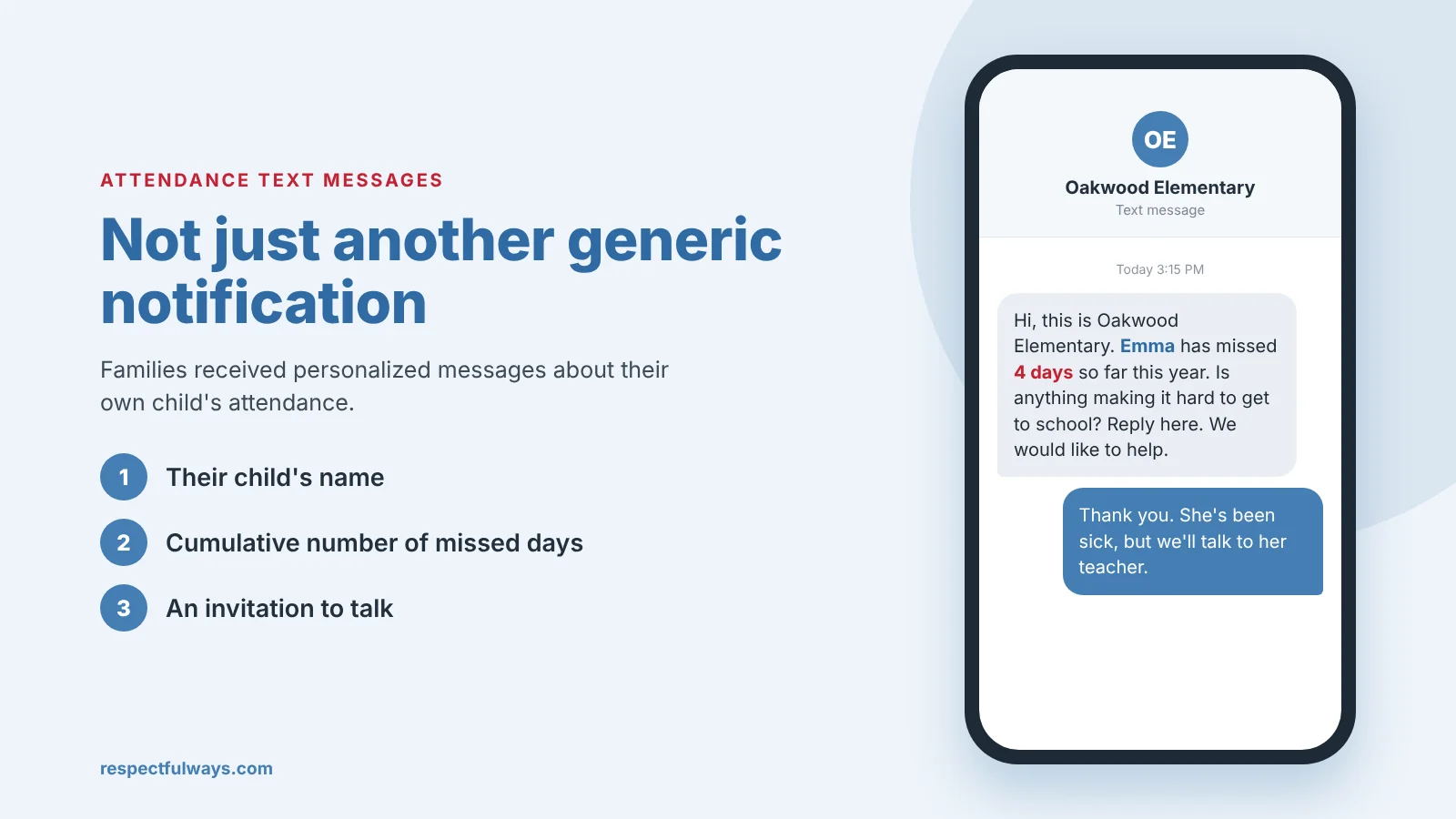
Families received attendance information, including personalized messages with their child’s name and cumulative number of missed days.
Parents May Not Realize How Quickly Absences Add Up
Think about how easily missed days accumulate.
- A Monday following a busy weekend.
- A Friday before a family trip.
- Several days of illness.
- An occasional day when a child simply doesn’t want to go.
Each absence may seem relatively small. But two missed days per month can add up to approximately 20 days during a school year. Some families may not recognize the cumulative impact. That’s why timely, specific communication matters.
The Trauma-Informed Difference
Here’s where we take the research one step further. Instead of communicating only:
“Your child has missed four days this year.”
Try:
“We’ve noticed your child has missed four days. Is there anything making attendance difficult? We’d like to help.”
The first message shares information.
The second communication invites a conversation.
A text won’t solve transportation problems, anxiety, illness, or family instability.
But it may help identify a barrier before absences become more persistent.
And for students with continuing attendance problems, personalized outreach from a staff member may be more useful than repeated automated reminders.
Trauma-informed SEL lessons for grades PreK-2, 3-5, 6-8 and 9-12
Use the Systems You Already Have
This doesn’t necessarily require another expensive program.
- Schools can explore using existing student information systems, automated communication tools, and established family outreach procedures.
- Let technology handle routine notifications.
- Reserve more personalized staff outreach for students and families who need additional support.
Automate the reminder. Personalize the follow-up.
That’s a practical way to make communication more intentional without expecting every teacher to personally contact every family.
Let’s Continue the Conversation
School leaders, are your attendance messages simply reporting absences, or are they helping families understand the problem and connect with support?
What’s working in your district?
Read more: School absenteeism on the rise: 16 ways to support students
How to Write Attendance Texts Families Will Read
The IES guide gives practical advice on making attendance text messages work. A few points to start with:
Keep each text under 160 characters, so it arrives as one message.
Include the child’s first name and the number of days missed so far this year.
Send messages in the family’s home language.
Make it easy to reply or reach a staff member, so a text can turn into a conversation.
A message that brings these together might read:
“Hi, this is [School]. [Name] has missed 4 days so far this year. Is anything making it hard to get to school? Reply here. We would like to help.”
Like this? Subscribe now for weekly trauma-informed SEL strategies, and get Part 3 in your inbox.
Attendance Text Messages FAQs
Do text messages reduce chronic absenteeism?
In a federal study in 108 elementary schools, attendance text messages to parents lowered the expected chronic absence rate of 20.5% by 2.4 to 3.6 percentage points, a drop of about 12–18%.
What should an attendance text message to parents include?
The child’s name, the number of days missed so far, and an invitation to talk. A trauma-informed message asks whether something is making attendance difficult and offers help.
How much does attendance text messaging cost?
In the federal study, the messaging cost about $7 to $8.50 per student for the school year.
Can text messages solve attendance problems on their own?
No. A text won’t solve transportation problems, anxiety, illness or family instability, but it can help identify a barrier early. Students with continuing attendance problems may need personalized outreach from a staff member.
Trauma-informed SEL lessons for grades PreK-2, 3-5, 6-8 and 9-12, or try a free course.
Research: IES, How to Text Message Parents to Reduce Chronic Absence; IES, Can Texting Parents Improve Attendance in Elementary School? A Test of an Adaptive Messaging Strategy.
This entry was posted in Blogs. Bookmark the permalink.
 Our 1st graders loved the Be Kind: It Feels Good course. The Kindness Hunt and bucket filling activities were the best. Very engaging.
 The Bored, Get Creative module was perfect for our 4th graders pre-winter break. We talked about things they could do if “bored”.