
Parents Need to Be Partners, Not Spectators
November 23, 2026

Part 3 of 4 | Helping families navigate today’s challenges while maintaining shared responsibility. FREE SEL Parent & Family Materials in English and Spanish.
Families play a critical role in getting students to school, but not every family faces the same challenges. Some need clearer expectations, while others need practical resources, guidance, or additional support. A trauma-informed approach recognizes these differences and helps schools build stronger family partnerships while reinforcing the shared responsibility for consistent attendance.
Missed Part 2? Before Another Expensive Attendance Initiative, Try Communication
Are Parents and Schools Defining Attendance Differently?
I’ve been hearing growing frustration from educators about parental involvement. Schools contact families, schedule meetings, send attendance notices, and offer support. But sometimes calls go unanswered, meetings are missed, and attendance doesn’t improve. And educators are understandably asking:
“Why are schools expected to take responsibility for everything?”
It’s a fair question.
Parents and caregivers are essential stakeholders in their children’s education. Schools cannot replace parental responsibility. But I also believe we need to recognize that some families are navigating challenges they don’t feel equipped to handle.
Parenting in a Different World
Many parents grew up without smartphones, social media, or constant digital connectivity. Now they’re raising children in an environment shaped by all three. Families are navigating screen-time boundaries, sleep routines, emotional regulation, anxiety, and school avoidance.
Some parents may need help recognizing when a child’s reluctance to attend school reflects a serious concern. Others may need guidance establishing consistent expectations. And some are dealing with financial, health, transportation, or family challenges that make regular attendance difficult.
We should not assume that every parent is disengaged. But neither should we ignore the importance of parental accountability.
Trauma-informed practice means understanding barriers while maintaining appropriate expectations.
What If We Educated Parents, Too?
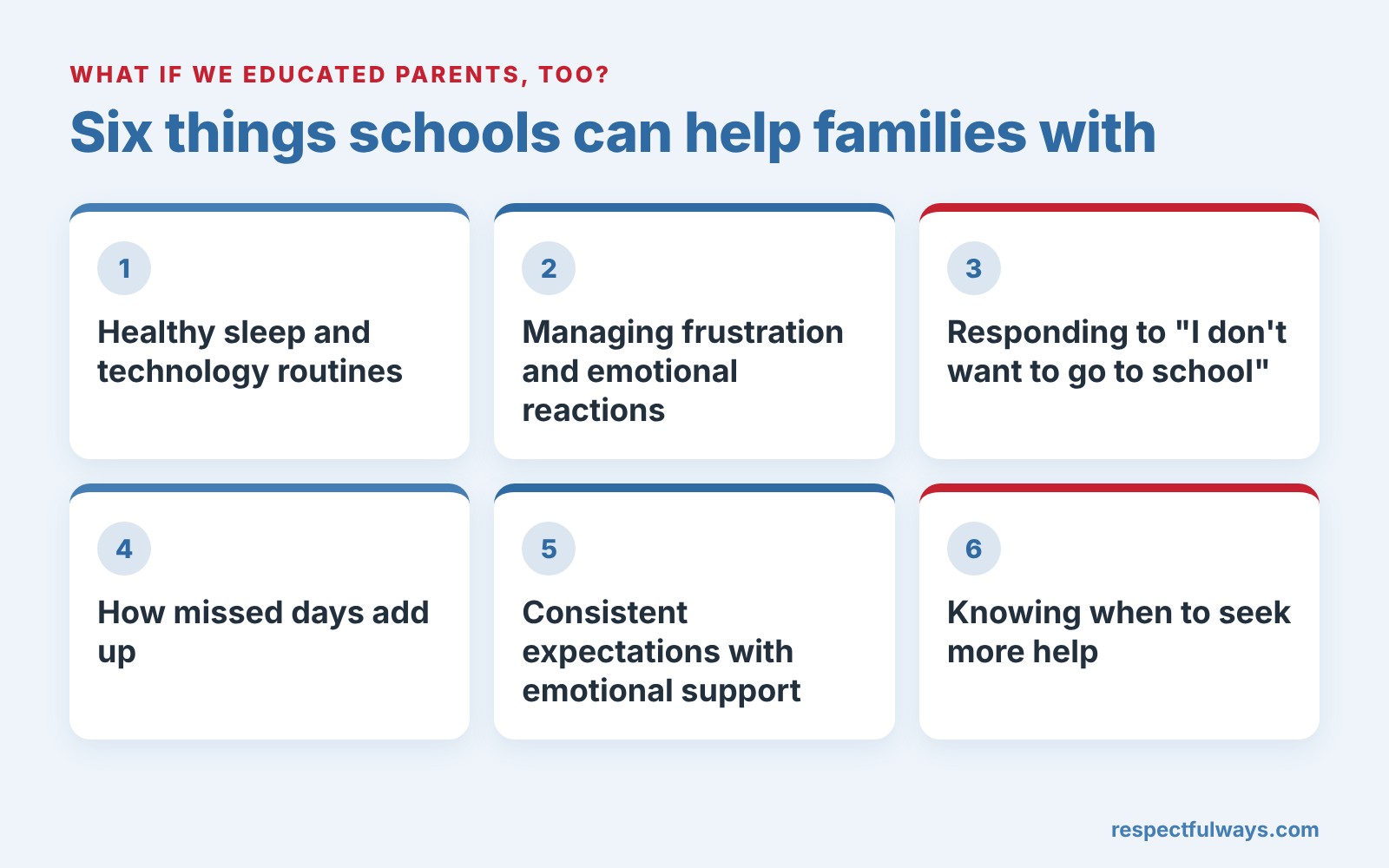
Schools and community partners could offer practical resources on:
- Creating healthy sleep and technology routines.
- Helping children manage frustration and emotional reactions.
- Responding when a child says, “I don’t want to go to school.”
- Understanding how missed days accumulate.
- Setting consistent expectations while providing emotional support.
- Knowing when to seek additional help.
These don’t have to become lengthy workshops.
Sometimes a one-page handout, conversation starter, or short video can help.
Free SEL Resources for Parents and Families
This is one reason we developed Home Connects through Respectful Ways, the trauma-informed social-emotional learning company I founded.
We offer 48 free Home Connects resources in English and Spanish for PreK–12 families.
These printable materials include learning objectives, Let’s Chat conversation questions, helpful Q&As, and simple family activities.
They reinforce important skills such as compassion, perseverance, respect, and responsibility.
Educators can print them or share them through ParentSquare, ClassDojo, or email.
They’re not a cure for chronic absenteeism.
But they can help families reinforce social-emotional skills at home and strengthen communication between home and school.
48 free Home Connects resources in English and Spanish for PreK–12 families
Let’s Continue the Conversation
Educators, what do you wish more parents understood about attendance, behavior, emotional regulation, or school expectations?
And parents, what information or support would help you feel more confident partnering with your child’s school?
Let’s have a conversation. You can reach me at pam@respectfulways.com or 404.955.8882.
Like this? Subscribe now for weekly trauma-informed SEL strategies, and get Part 4 in your inbox.
Family Partnerships and Attendance FAQs
Why do family partnerships matter for school attendance?
Families play a critical role in getting students to school, but not every family faces the same challenges. Some need clearer expectations, while others need practical resources, guidance or extra support. A trauma-informed approach recognizes these differences while keeping attendance a shared responsibility.
What can schools help parents learn about attendance?
Healthy sleep and technology routines, helping children manage frustration, responding when a child says “I don’t want to go to school”, how missed days add up, setting consistent expectations with emotional support, and when to seek more help. A one-page handout, conversation starter or short video is often enough.
Are there free SEL resources for parents?
Yes. Respectful Ways offers 48 free Home Connects resources in English and Spanish for PreK–12 families. Each includes learning objectives, Let’s Chat conversation questions, helpful Q&As and simple family activities.
How can teachers share Home Connects with families?
Teachers can print them or share them through ParentSquare, ClassDojo or email.
Can parent resources solve chronic absenteeism?
No. They’re not a cure for chronic absenteeism, but they can help families reinforce social-emotional skills at home and strengthen communication between home and school.
Trauma-informed SEL lessons for grades PreK-2, 3-5, 6-8 and 9-12, or try a free course.
This entry was posted in Blogs. Bookmark the permalink.
 Our 1st graders loved the Be Kind: It Feels Good course. The Kindness Hunt and bucket filling activities were the best. Very engaging.
 The Bored, Get Creative module was perfect for our 4th graders pre-winter break. We talked about things they could do if “bored”.